If you're wondering whether you should name your new kitten Max or Luna, you might think the answer is as easy as taking a peek between its legs. However, determining kitten gender can be tricky when they are very young. For best results, look below the tail.
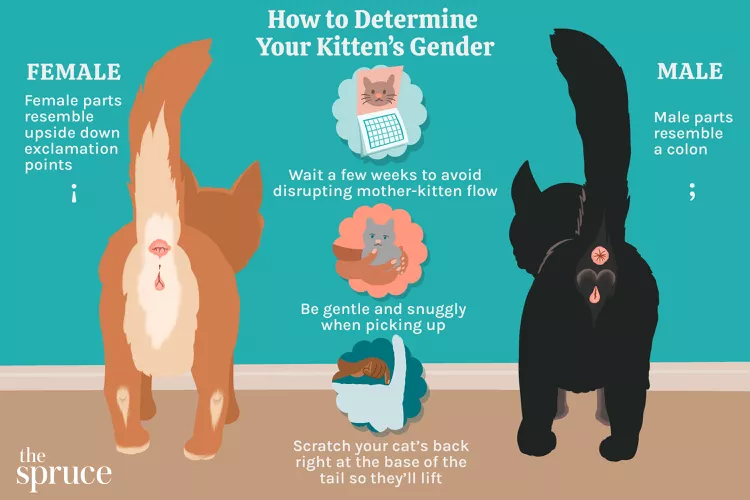
- If the cat is a female kitten, you'll see what resembles a lowercase letter "i"
- If the cat is a male kitten, you'll see what resembles the colon punctuation mark (:)
Along with genital shape and spacing, you can also use clues such as coat color to determine whether a kitten is male or female, and at times, there are even behavioral clues that will guide you to the answer.
But don't disrupt the mother-kitten flow within the first few weeks of life. If a kitten is handled too much during this time, the mother may abandon it and stop nursing it altogether. So don't get too anxious to determine the sex of your kittens. Instead, wait until at least two weeks—or preferably longer—to start handling your kittens.
Identifying the Genitals
At two weeks old, some breeders liken the appearance of kitten genitalia to punctuation marks.
- A female kitten's genitals will resemble an upside-down exclamation point, with the vertical vaginal slit sitting just below the anus and with very little spacing in between (when the cat is upside down and facing you).
- A male kitten's organ looks more like a colon, with the penis residing just below the anus and separated by enough space to accommodate his testicles. You may even be able to see small lumps in that space, which will grow as the kitten matures.
If, upon visual observation, every kitten looks the same to you, then pick one and gently place your finger and thumb on either side of the scrotum area (on a suspected boy). You may palpate two small, hard, oval-shaped objects under the skin. These are the testes, and they are almost impossible to hold—they will retract from your fingers. If testes are present, your kitten is male.
Coat Color
Another simpler, but less reliable, way to tell the sex of your kitten is by the color of its coat.
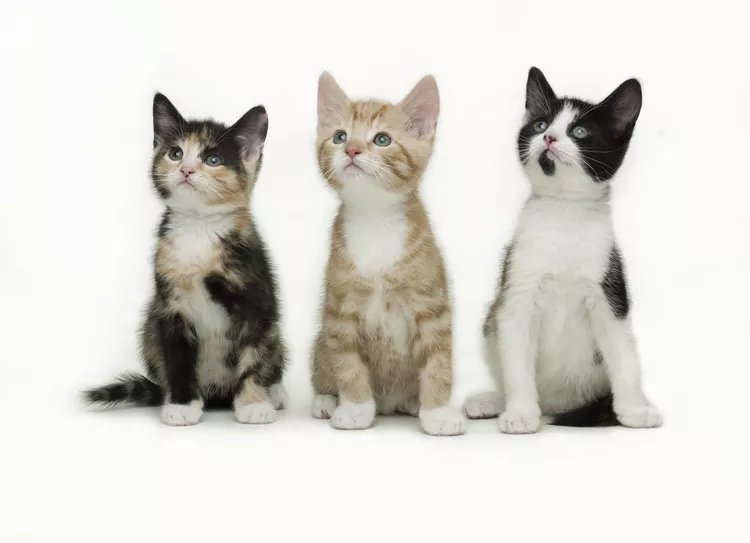
- Tortoiseshell or tri-colored cats are almost always female. The chromosomal makeup of female cats is solely responsible for this coloration, so you can pretty much guarantee any calico cat is a girl as well.
- Orange or ginger-colored cats, however, are most often male (think of the iconic male tabby cats). Yet, this trait is not as reliable as the tri-colored trait, as only three-quarters of ginger-colored cats are male.
Behavior
As kittens become bigger, they start to develop their unique personalities.
- Male "tom kittens" may start to roam as they approach sexual maturity. They may also become territorial, often spraying to establish their home base and ward off trespassers. Males may also be more restless and aggressive.
- Female kittens (sometimes as young as four months) may go into heat—vocalizing this "coming of age" with loud yowls and attention-seeking behavior. However, the earlier you spay or neuter your kitten (the standard recommendation is five to six months but spaying or neutering can happen as early as six weeks) the less your cat will display these gender nuances.
Some people claim male cats are friendlier and more outgoing than females. But this difference is by no means universal, and cat personalities are almost as varied as human personalities. So choose your pet by the connection you make upon first interaction, and pay less attention to sex.