Cats are only grabbed by the scruff on their neck in limited circumstances, and none of these situations are helpful to mimic in a home, veterinary or shelter setting, yet some people recommend to scruff your cat to discourage bad behavior. We all want what is best for our cats, and there are more effective and kind ways to correct behavior in our feline friends. Find out why it is not recommended for you to scruff your cat to discourage bad behavior.
What Is Scruffing?
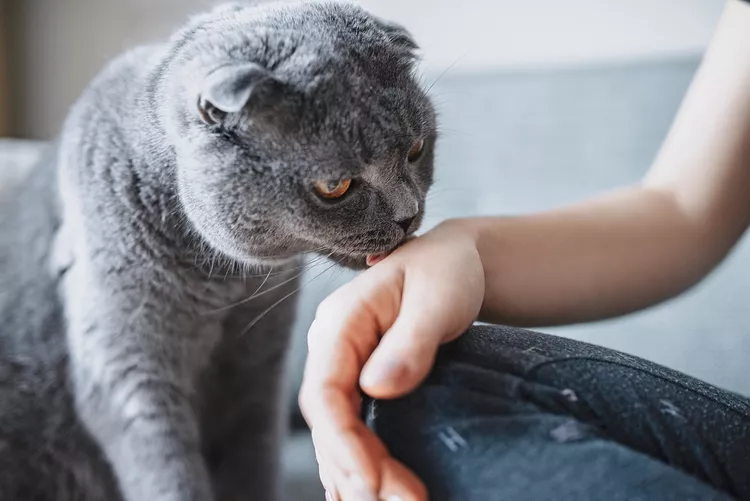
Scruffing is a general term for a variety of holds on the skin of a cat’s neck. Grasping the scruff of the neck varies from a gentle squeeze of skin to grasping a larger fold of skin with varying amounts of pressure, and sometimes is accompanied by lifting the cat up or heavily restraining the cat in other ways.
Why and When Are Cats Scruffed?
As Kittens: Kittens go limp due to a flexor reflex. This reflex is only present during the first few weeks of the kitten's life. Mother cats grab kittens by their scruff only in the first few weeks of life to transport them. They do not do this to discipline them, which is a common myth. It's important to remember that we, as humans, are not cats. A mother cat knows the precise pressure to place on the skin at the back of the neck and cats have pressure sensors on their teeth, which explains why they have the ability to carry a mouse in their mouths without making a scratch.
Attacked by a Predator: When cats get grabbed by predators, a large bird of prey, for example, they are commonly grabbed by the scruff of their necks.
Mating: During mating, the male cat will mount the female from her rear, holding her by the scruff of her neck with his teeth. This is believed to immobilize the female and provide proper orientation for mounting as well as be a defensive move on the males part because female cats often attack males during mating. Male cats' genitals are covered with small keratinized spines that serve the purpose of stimulating ovulation of females which can be painful for the female cats hence why female cats can often attack the male cat during mating.
Cats are only grabbed by the scruff on their neck in limited circumstances: During the first few weeks of life by their mother, during mating, fighting, and when they are being attacked by a predator. None of these situations are helpful to mimic in a home, veterinary or shelter setting.
Using Scruffing to Discourage Bad Behavior
It is a common myth to use scruffing to discourage bad behavior in your cats. As stated above, mother cats do not scruff kittens to punish them, and it causes fear and stress. When training your cat, using fear and punishment is not recommended for a variety of reasons.
Can increase fear anxiety, and stress: There is always a reason for behavior. Cats are not spiteful when they display undesirable behaviors, and commonly, they are natural behaviors for the cat. Punishing your cat can increase anxiety and cause cats to feel insecure. Not feeling safe in your own environment and stress is often a cause for the unwanted behaviors.
Can damage your relationship with your cat: When cats are doing things we do not want, we can react in a way that startles our cats. This includes shouting, scruffing, throwing things, and spraying water. These methods can cause your cat to become scared and anxious around you, lose their trust in you, associate the punishment with you and not the behavior, and increase behavior issues due to increase fear and anxiety.
Can result in aggression: One of the most common reasons cats exhibit aggressive behavior towards humans is due to fear. If you were scared and someone grabbed you, many of us would instinctually resort to aggressive behavior, pushing the person away or punching them, this is true of animals too.
Does not teach the cat the wanted behavior and does not effectively communicate with your cat what you do want: Punishment may stop your cat from doing whatever they are doing at that moment, but it does not teach the cat what you want. Often, cats will not know what they are being punished for, will learn to engage in the unwanted behavior when you are not around, or increase the already-present behavior since it is very difficult for punishment to be effective. In order for punishment to be effective, the punishment must be administered within a second or two of the unwanted behavior, must occur every time the behavior occurs, and must be aversive enough to stop the cat from repeating the behavior in the future but not so aversive as to frighten the cat.
Your cat deserves better: Your cat relies on you to take care of them. When addressing their behavior problems, we should address them compassionately and productively.
The best way to discourage your cat’s bad behavior is to find out why they are doing it and then offer a better solution. Often when cats are exhibiting unwanted behaviors like destructive scratching or going outside the litter box, they are telling us that something is not right and as their caregivers, we need to listen. This can be due to medical issues, stressors in their environment, them not feeling safe, not enough resources, and more.