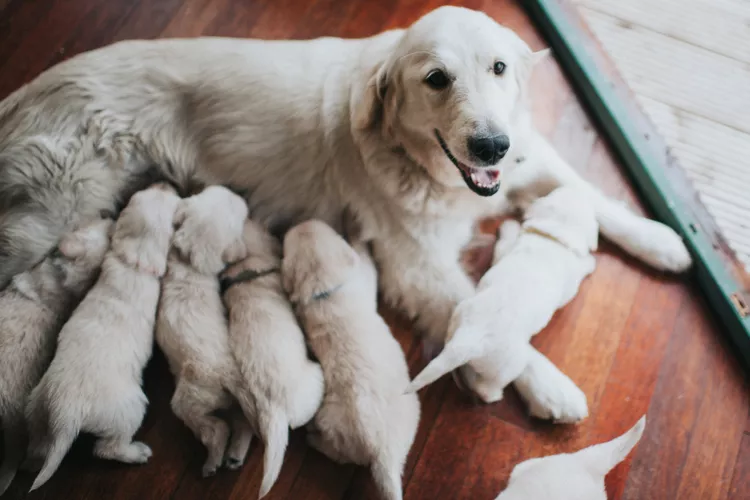
If your dog is close to giving birth for the first time, it's important to prepare yourself to help with the delivery. The good news is that most dogs don't need help when delivering puppies—they know what to do on their own. You should, however, know the signs that your dog is going into labor soon, as well as signs that your dog is having trouble giving birth.
Read on to find out how to properly help a dog giving birth for the first time.
How to Prepare for Dog Giving Birth For the First Time
First, you should talk to a veterinarian early on in the pregnancy about the labor process. It's best to find a vet who has experience and interest in canine reproduction so they can best prepare you for what to expect, including abnormal complications. It is also a good idea to talk to an experienced dog breeder and consider having that person present for the birth.
How Dogs Act Right Before They Give Birth
A pregnant dog typically shows signs of nesting within about 48 hours of the onset of labor. These signs may include scratching at her bed and looking for a safe place to have her puppies. You should begin to take your dog's rectal temperature once or twice a day as her due date approaches. Normal body temperature is about 100-102°F. When the rectal temperature drops below 100°F, this is a good sign that labor will begin within 24 hours.
During the first stage of labor, your dog will begin to experience uterine contractions. She may also start pacing or digging. Many dogs will pant or shake. Some dogs even vomit. This is all considered normal behavior and typically lasts for six to 12 hours until the cervix dilates and she is ready to deliver her pups.
How to Help Dog Giving Birth
When your dog first goes into labor, the best thing you can do is keep your distance while quietly observing her. It may surprise you to learn that dogs don't typically need much help giving birth, even if your dog is giving birth for the first time. In fact, it can be quite fascinating to watch a dog's instincts take over as they whelp and nurse their young.
Here's how to help without interrupting the natural process:
- Clean the puppies: The mother should do this instinctively, but if she doesn't, you'll need to assist. Carefully remove the membrane covering the puppy using your fingers, then gently rub the puppy clean with a towel. Tie the umbilical cord with umbilical tape, string, or floss (unflavored and unwaxed) about a half inch from the puppy's belly, taking care not to tug on the cord. Cut the cord with sterilized surgical scissors about an inch and a half away from the puppy. The cord should fall off on its own in a few days.
- Monitor mom's placenta intake: In between pups, the mother may or may not try to eat the placenta from the previous pup. Keep an eye on her, as ingesting too much placenta in a short amount of time may cause her to have an upset stomach.
- Let mom take a break: About halfway through delivering the pups, the mother may need to take a break; up to four hours may pass before she begins to strain again. There is no cause for concern unless she goes longer than four hours before beginning to deliver the next pup. Hopefully, you have an idea of the final number of pups and their sizes. Your vet may take x-rays around day 45 to determine the number of puppies.
Signs of Complications
Some puppies may be born tail first. This is not abnormal and is not usually a problem unless the pup seems stuck. Call your veterinarian right away if any of the following occurs:
- Your dog does not go into labor within 24 hours of her temperature dropping below 100°F.
- She is straining/having contractions for more than 45 minutes, and no puppy is born.
- A puppy appears to be stuck in the birth canal, or the puppy is halfway out, and the mother cannot push the puppy anymore.
- It has been more than four hours since the last pup, and you know there are more inside.
- She appears to be in extreme pain.
- The gestation period has reached 70 days.
- You have other concerns about the mother or her puppies.
When in doubt, contact a veterinarian with questions. Ideally, you will already have a relationship with a vet experienced in canine reproduction.
-
How long can a dog be in labor without pushing?
A dog can be in labor up to 24 hours prior to pushing.
-
How long can a dog be in labor?
Canine labor usually lasts from three to 12 hours.
-
How do you induce dog labor at home?
They are ways to help induce your dog's labor. First, take your dog for a short, and not arduous, walk. Second, try massaging her nipples; this can stimulate her contractions. Third, try gently massaging her abdomen starting at her sides.
-
How long does the first stage of dog labor last?
The first stage of dog labor typically lasts from six to 12 hours.
-
How many puppies can a dog give birth to for the first time?
Dogs typically give birth to an average of 6 to 8 puppies, but the final number can vary.
-
How many puppies usually survive in a litter?
Survival rate of newborn puppies is based on a variety of factors, including the health of the mother, delivery complications, aftercare and more. If labor goes off without a hitch and the mother has the capacity to nurse all the puppies, then there's no reason all the puppies can't survive. But sometimes, a litter will lose a few puppies, especially in a larger litter.